| Search |


a division of the American
Chemical Society

You have reached the Older version of the Website for the
Division of Polymer Chemistry, Inc.
This website is not being updated as of July 2018.
Please visit the NEW POLY website at:
Advancing the world through polymer chemistry

| Search |
September 5th to 9th 1999
Second circular
Macromolecules ’99
Polymers in the new millenium
University of Bath
September 5th to 9th 1999
MacroGroup UK
ACS Division of Polymer Chemistry, Inc.
European Polymer Federation
The Meeting
Macromolecules ’99 is the fifth meeting jointly organised by the MacroGroup UK and the Polymer Division of the ACS and is also organised under the auspices of the European Polymer Federation. Macromolecules ’99 is the fourth in the series to be held in the UK and continues the tradition of holding these meetings in historic and picturesque venues, on this occasion the city of Bath. Delegates will also have the opportunity to register for the Institute of Physics Polymer Physics Meeting to be held at the University of Sheffield at a special combined registration fee.
The programme will be organised on the traditional format of opening plenary sessions followed by a series of parallel sessions designed to accommodate a wide range of interests in polymer science and technology. Approximately fifty eminent polymer scientists have accepted invitations to present Plenary and Keynote Lectures, which will lead the parallel sessions. There will be opportunities for a significant number of contributed papers and the poster session will be an integral part of the programme. This second circular gives details of the deadlines for submission of contributed papers. Delegates wishing to present a paper at this meeting are strongly advised to adhere to these dates because a significant number of contributions were offered as a result of the first circular. Although the Programme Committee will give preference to high quality contributions, once the programme has been decided, it may too difficult to accommodate papers that are submitted late as oral contributions.
The meeting will also be the occasion on which the MacroGroup medal will be presented for distinguished contributions to Polymer Science.
The venue: The University of Bath
The University is of modern construction and occupies a campus on the outskirts of the city. It is well equipped for conferences with hotel-style en-suite accommodation, has excellent sports facilities within walking distance of the conference centre and there is a regular bus service to the city.
The city of Bath
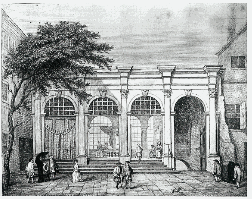
The city of Bath dates from Roman times and the Roman Baths are still in excellent condition. Much of the city was rebuilt during the eighteenth century, when it became a fashionable place to visit in order to "take the waters". The architecture is spectacular with many wonderful streets, parks, and buildings that make a visit to Bath a delight. Indeed the scale and importance of the architecture led to Bath being named a World Heritage City by UNESCO. Set in the south west of England, Bath is close to some beautiful countryside, the Cotswolds, the Cheddar Gorge, Devon and Cornwall, and interesting centres such as Oxford and Bristol.
Travel to Bath
Bath is located 117 miles (187 km) west of the centre of London, 104 miles (166km) from Heathrow Airport. There are excellent road and rail links between Bath and London and other major cities in the UK. A shuttle bus service will be available from Bath Spa railway station from 2.00pm on Sunday 5th September to transport delegates from the railway station to the University campus.
The scientific programme of invited speakers
Monday 6th September
Professor H Finklemann, University of Freiburg
Liquid crystal elastomers
Professor A C Balazs, University of Pittsburgh
Modelling mud, sludge and custard (or colloids in polymer mixtures).
Co-ordination metallocene catalysis
Professor V Gibson, Imperial College of Science, Technology and Medicine
New catalysts for controlled olefin polymerization
Professor M Brookhart, University of North Carolina at Chapel Hill
Olefin polymerisations using late transition metal catalysts: mechanistic and synthetic studies
Conventional radical polymerization
Professor B Klumperman, Eindhoven University of Technology
Recent advances in controlled radical polymerisations
Dr S Howdle, University of Nottingham
Supercritical fluids: from polymer synthesis to biomaterials
Living radical polymerization
Professor K Matyjaszewski, Carnegie Mellon University
New materials by controlled radical polymerization.
Dr G Moad, CSIRO
Living Free Radical Polymerization with Reversible Addition Fragmentation Chain Transfer - or - the Life of RAFT
Surfaces and thin films
Professor T P Russell, University of Massachusetts at Amherst
Manipulating polymers in thin films
Professor G Fleer, Wageningen Agricultural University
Analytical approximations to numerical SCF descriptions for polymer adsorption from dilute solutions
Colloids
Dr P A Lovell, UMIST
Polymer colloids -current status and future perspectives
Professor A M Donald, University of Cambridge
Starch - where polymer physics meets food.
Polymer theory
Professor C A Angell, Arizona State University
On the dynamics of relaxation, disentangling and folding in organic and inorganic heteropolymers: a forward look
Professor G R Davies, University of Leeds
How do they move? - Application of molecular simulation techniques to the physics of solid polymers
Electroluminescence
Dr O Iganas, University of Linkoping
From micro- to nano-electronics with macromolecules
Professor J Kido, University of Yamagata
Materials design and device architecture in polymer EL devices
Inorganic liquid crystal polymers
Dr P Styring, University of Hull
Side-chain liquid crystal polymers and ‘Virtual Polymers’ derived from co-ordination complex and heterocyclic containing monomers
Professor R Descheneaux, University of Neuchatel
Ferrocene and [60] fullerene based liquid-crystalline macromolecules: new anisotropic materials
Organic liquid crystal polymers
Professor V Shibaev, Moscow State University
Field responsive chiral photochromic side-chain liquid crystalline polymers and liquid crystalline dendrimers
Professor R Zentel, University of Wuppertal
Liquid crystalline order as a tool to tune macroscopic materials properties
Tuesday 7th September
Professor T McLeish, University of Leeds
Theory, rheology and neutron scattering on controlled-synthesis branched polymers
Professor H Sakurai, Science University of Tokyo
Tailoring the structure and functions of polysilanes
Stepwise/novel synthesis
Professor Dr H Ritter, Johannes Gutenberg - Universitat Mainz
New types of photosensitive polymers bearing mesoions, nitrones or 3-oxopyridinium betaines
Professor P Hodge, University of Manchester
Ringing the changes - Recent work on cyclic oligomers
Analysis
Professor K Schmidt-Rohr, University of Massachussetts
Solid-state NMR studies of polymer structure and dynamics: Recent results and future challenges
Dr M J Miles, University of Bristol
Future force microscopy: Imaging and beyond
Structure-properties
Professor A J Ryan, University of Sheffield
How do polymer crystals nucleate?
Professor E Malmstrom, Royal Institute of Technology
Modification of dendritic polymers based on bis-methylol propionic acid
Professor C De-Armitt, YKI Institute for Surface Chemistry
Systematic optimisation of dispersant structure to create polypropylene composites with improved mechanical properties and thermal stability
Inorganic polymers
Professor J Chojnowski, Polish Academy of Sciences
Polydimethylsiloxanes regularly interrupted by oxygen - Polysilaethers
Dr M Tanaka, NIMC
Transition metal-catalysed synthesis of thermally stable silicon-containing polymers
Professor R West, University of Wisconsin
Polysilanes
Professor I Manners, University of Toronto
Supramolecular inorganic polymer chemistry: self-assembly of poly(metallocene) block copolymers
Electrorheological fluids
Professor H Block, University of Cranfield
Conducting polymers as substrates in electro-rheology
Mr W Bullough, University of Sheffield
Smart machines and ER fluids
Biodegradation
Professor A-C Albertsson, Royal Institute of Technology, Stockholm
Polymers in the new millenium
Dr G Swift, Rohm and Haas
The facts and fiction on biodegradable polymers
Wednesday 8th September
Professor W J Feast, University of Durham
Ordered and disordered electroactive polymers: synthesis and properties
Structure properties
Professor M Mackley, University of Cambridge
The use of novel processing techniques to control microstructure and product properties.
Professor R Legras, Catholic University of Louvain
Nanoporous membranes, nanotubules and nanowires: structure properties relationship of monodimensional bodies
Photo degradation
Professor J-L Gardette, URA CNRS 433 - Universite Blaise Pascal
Oxidation of polypropylene - do we know everything?
Biodegradation
Professor E Chiellini, Universita di Pisa
Environmentally degradable polymeric materials-what’s ongoing under the sun?
Professor F Schué Université de Montpellier
Synthesis and degradation of polyesters.
Thursday 9th September
Professor D Tirrell, Caltech
Control of macromolecular structure and function via the protein biosynthetic apparatus of microbial cells
Professor J McGrath, Virginia Tech
Recent advances in phosphorous containing homo and copolymers, miscible blends and hybrid systems
Structure properties
Dr P Mills, ICI plc
Film Formation-Polymer Process-Properties Interaction
Dr S Rannard, Unilever Research, Port Sunlight
Synthesis of dendritic polymers using novel selective chemistry
Biomaterials
Professor M Vert, CRBA Université de Montpellier
Degradable and biodegradable polymers as sources of bio- and eco-materials : dreams and reality
Professor R Ottenbrite, Virginia Commonwealth University
Biodegradable polymers as drug carriers
Thermal degradation
Professor G. Camino Universita di Torino
Developments in fire retardant polymers: from formulation to chemical approach
Professor G. A. George, Queensland University of Technology
Self assembled monolayers as models for oxidative degradation and restructuring of polymer surfaces
Polymer Physics Group Meeting
Arrangements will be available for delegates to register for Macromolecules ’99 and the annual meeting of the Polymer Physics Group at a specially reduced price. Details of these arrangements are on the registration form.
Contributed papers
The meeting will include oral communications (20 minutes including discussion) and posters. Facilities for the presentation of standard slides and transparencies will be available. Instructions for the presentation of posters will be given on acceptance of the contribution.
Participants planning to present a contributed paper or poster should complete the Author’s form enclosed with this circular and send it together with an abstract, maximum two pages, that conforms to the format set out in the Abstract Form. Abstracts should be received before July 1st 1999. The Local Organising Committee will be responsible for the organisation of the programme and the schedule of presentations. The Local Organising Committee will inform authors of acceptance of presentations.
Preprints
The abstracts of invited and contributed lectures and posters will be included in a volume of preprints, which will be included in the registration pack of all participants.
Publication
Invited lectures and a limited number of contributed lectures will be published in a special issue of Polymer International. Authors wishing to publish their contribution should indicate this on the Author’s form. The communication should be written as a full paper (maximum 6 pages) using the author instruction, that will be provided by the Secretariat; manuscripts must be received by August 1st 1999.
Accompanying Persons
A full programme of events will be organised for accompanying persons, which will include visits to local stately homes and places of interest such as Cheddar Gorge and the Cotswolds. The fee will include all entrance charges and lunches will be provided.
Registration
Delegates should register for the meeting by completing the form enclosed with this second circular, which may be photocopied for multiple registrations. Registration may be for the whole period of the conference or on a per diem basis. Please indicate on the registration form(s) the type of accommodation requested for the period of the conference. Hotel-style University accommodation is available but preference will be given to those who attend the whole conference, as such accommodation is limited. Limited University accommodation is available for those who wish to arrive on Saturday 4th September or stay until 10th September. Outside of these dates accommodation is available in Bath. Assistance is available for those who wish to stay in a hotel or guest-house.
Payment should accompany registration and should be made in Sterling (GB pounds).
Cheques, Eurocheques or bank drafts, drawn in Sterling, should be made payable to Macromolecules ’99. Cheques drawn in any other currency or foreign cheques drawn in Sterling cannot be accepted.
Payment may also be made by bank credit transfer to:
Lloyds Bank,
Aston University Branch,
Priory Queensway,
Birmingham, B4 7HZ, UK.
Sort code: 30-96-28
Account number: 0330833. Account name: Macromolecules ’99.
Please ensure that all bank charges are paid before transfer, if payment is made by credit-transfer, and that your name is clearly stated on the transaction. It would be appreciated if a photocopy of the transfer details were to accompany the registration form.
 Registration Form (MS.word) Registration Form (MS.word)(don't click - - hold the mouse button down and try to figure out how to save this link as a file) |
Registration fees
|
Registration fee |
Before 1st August |
After 1st August |
|
Members of societies affiliated to IUPAC |
£200 |
£240 |
|
Non-members |
£250 |
£300 |
|
Students |
£50 |
£50 |
|
Daily rate |
£80 |
£100 |
|
Accompanying person |
£120 |
£120 |
Accommodation
Accommodation is available in student residences at the University on a Bed and Breakfast basis. The University provides three classes of accommodation
- Standard single bedroom with washbasin £20.75 per night
- Single bedroom with en-suite shower and WC £29.00 per night
- Polden Court single bedroom with full en-suite £36.00 per night
- Polden Court double bedroom with full en-suite £62.00 per night
Reservations should be indicated on the accommodation form that accompanies this second circular. Accommodation in the University is limited and preference will be given to those who register for the whole conference.
The City of Bath, being a tourist city, has a wide range of Hotels and Guest-houses that provide good quality accommodation. Details of this style of accommodation are available on request but the organisers are unable to undertake to make bookings. Please indicate on the accommodation form that you wish to receive details of Hotels and Guest-houses.
Lunches, dinners and Conference Banquet
Morning coffee and afternoon tea on the days of the meeting are included in the registration fee. All other meals are to be paid in advance. Tickets will be included in the registration pack for those meals that are pre-purchased. The cost of the meals is as follows:
Lunch (Self-service) £8.50 Dinner £9.50
Conference Banquet £35.00
Please indicate your requirements on the registration form
Social Programme
Sunday evening: buffet dinner served from 7.00 - 8.30 pm followed by mixer.
Monday evening: reception followed by a poster session in the Senior Common Room.
Tuesday evening: reception followed by a poster session in the Senior Common Room.
Wednesday, afternoon: visit to local attractions such as Cheddar Gorge, SS Great Britain and Berkeley Castle.
Wednesday, evening. Reception at the Roman Baths followed by conference dinner to be held at the Guildhall. Alternative arrangements will be made for those not attending the conference dinner.
Local Organising Committee
|
A J Amass |
University of Aston |
D Lacey |
University of Hull |
|
N C Billingham |
University of Sussex |
W MacDonald |
Dupont Ltd |
|
J R Ebdon |
University of Lancaster |
G Price |
University of Bath |
|
D M Haddleton |
University of Warwick |
S Rannard |
Unilever Ltd |
|
R G Jones |
University of Kent |
R W Richards |
University of Durham |
|
P G Klein |
University of Leeds |
B J Tighe |
University of Aston |
International Organising Committee
|
M Antonnietti |
Teltow |
A E Ledwith |
Sheffield |
|
W J Brittain |
Akron |
L Monnerie |
PCMS, Paris |
|
F Ciardelli |
Pisa |
S Penczek |
Lodz |
|
J M G Cowie |
Heriot Watt |
F Schue |
Montpellier |
|
J Devaux |
Louvain |
D Seyferth |
MIT |
|
A Eisenberg |
McGill |
R S Stein |
UMASS |
|
W J Feast |
Durham |
M Tanaka |
NIMC, Ibaraki |
|
G George |
Queensland |
R Townsend |
Imperial College |
|
J S Higgins |
Imperial College |
J-P Vairon |
UPMC, Paris |
|
K Kramer |
Mainz |
G Wegner |
Mainz |
|
H R Kricheldorf |
Hamburg |
R Weiss |
Connecticut |
Further Information
Dr A J Amass, Macromolecules ’99, CEAC, Aston University, Aston Triangle, Birmingham B4 7ET, UK. Email a.j.amass@aston.ac.uk
Fax (44) 121 359 4094 Tel (44) 121 359 3611
