| Search |


a division of the American
Chemical Society

Division of Polymer
Chemistry, Inc.
Advancing the world through polymer chemistry

| Search |
2017 Committee Reports:
2017 Spring ACS National Meeting in San Francisco, April 2-6, 2017
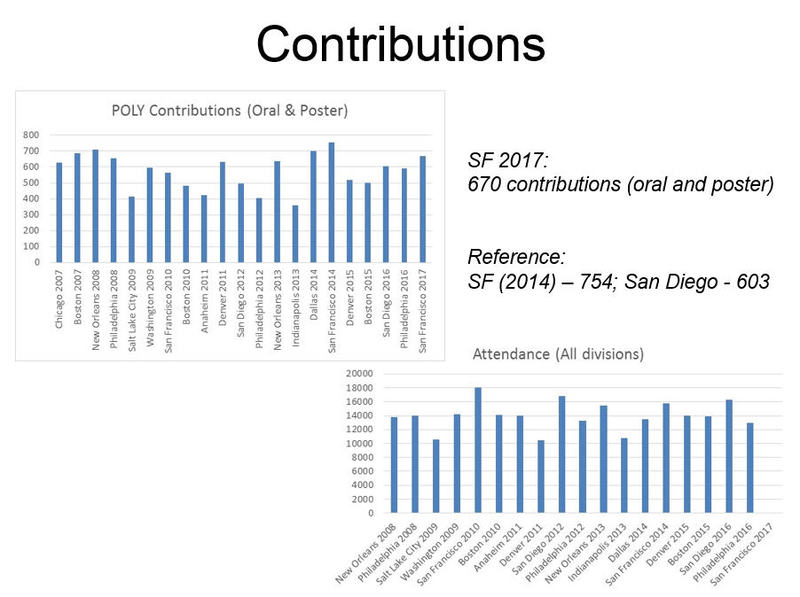
The 253rd American Chemical Society National Meeting & Exposition held April 2-6 in San Francisco, CA with a theme of Advanced Materials, Technologies, Systems & Processes, was record setting with over 18,500 registered attendees. The ACS Council at its April 5th meeting took the following actions:
• By electronic ballot, the Council selected Bonnie A. Charpentier and Willie E. May as candidates for 2018 President-Elect. These two candidates, along with any candidates selected via petitions, will stand for election in the Fall National Election.
• A recommendation by the Council Policy Committee to approve the Petition for the Removal of Officers and Councilors (Bylaw III, Sec. 1, i; Bylaw VII, Sec. 1, c; Bylaw VIII, Sec. 4, d) failed.
• The Council approved the Petition on the Rights of Affiliates (Bylaw II, Sec. 1, a, 2, a, 3, b, (3) and (4)).
• The Council voted on the recommendation of the Committee on Budget and Finance to set the member dues for 2018 at the fully escalated rate of $171. This rate is established pursuant to an inflationadjustment formula in the ACS Constitution and Bylaws. It continues to put ACS near the medium cost compared to other scientific organizations.
• On the recommendation of the Committee on Divisional Activities, the Council approved keeping the formula the same for allocating dues funds to divisions, effective with allocations for 2017 division performance. The Divisional Activities Committee (DAC) is planning to bring a new allocation formula to Council next spring to incentivize divisions to program more at regional and international meetings. A DAC taskforce will look into how this might be carried out.
The Council also conducted a special discussion, “ACS Yesterday and Today: Paving the Way to Tomorrow,” to gather input for the Joint Board-CPC Task Force on Governance Design. Forty Councilors approached the floor microphones to share observations, comments, and suggestions to assist the task force in identifying opportunities and issues for governance improvement. The task force offered three questions to guide the discussion: What should the Society and its governance do differently to achieve its objectives? If you could change one thing about ACS governance, what would it be? What should the task force leave “as is”? A poll conducted at the conclusion of the discussion revealed that more than half of the Councilors think the current governance structure, processes and procedures should be changed to achieve the objectives of ACS in the 21st century. They are interested in your thoughts which can be shared at governancedesign@acs.org.
In 2016, ACS generated a Net from Operations of $23.8 million, which was $7.2 million higher than 2015. Total revenues were $526.8 million, increasing 2.9% or $15 million over 2015. Expenses ended the year at $503 million, which was $7.8 million or 1.6% higher than prior year. This was attributable to a continued emphasis on expense management across the organization. The Society’s financial position strengthened in 2016, with Unrestricted Net Assets, or reserves, increasing from $163.3 million at December 31, 2015 to $206.5 million at year-end 2016.
As of December 31, 2016, the ACS membership was 156,129, which is 0.5% less than on the same date in 2015. The Society’s overall retention rate is 83.5%. The Committee on Membership Affairs also reported that the number of international members has increased to 27,388, exceeding the committee’s target by 5%. Retention of graduate students increased by 2% to 76.2%.
I am happy to report that the membership in the POLY division remains strong. One news item of interest is that Brent Sumerlin (University of Florida) has been appointed Chair of the Membership Committee. In addition, Brian Long (University of Tennessee) and Katrina Knauer (BASF) have joined Mary Ann Meador (NASA), Michael Meador (NASA), and Alan Hopkins (The Aerospace Corporation) as committee members. We look forward to their contributions to the membership and appreciate their service.
The Division continues to offer free POLY membership to new members or if you have not been a member for three years. Sign up on-line at http://polyacs.net/Membership/memberapp.htm. While Division officers and the membership committee strive to recruit new members at the national meetings, there are plenty of other opportunities to recruit including regional and local section ACS meetings or other polymer-focused conferences. Anyone interested in running a membership drive for POLY, please contact Kevin Cavicchi (kac58@uakron.edu) or Kathy Mitchem (kathyl@vt.edu) to receive a simple, easy to use, recruiting packet.
In Student Chapter news, the University of Michigan POLY/PMSE Student Chapter received the Best POLY Chapter for their activities in 2016. Outstanding achievements for the chapter in the past year include several initiatives in polymer science education and outreach. The chapter’s “Exploring Polymer Science” outreach initiative included visits to 15 K-12 schools ( ~1700 students) in the greater Detroit area. Chapter involvement in Xplore Engineering, an event to teach children and grandchildren of UM alumni about various aspects of engineering, was highly successful and well-received in the community. The UM student chapter’s outreach efforts were summarized in a recent manuscript on strategies to incorporate polymer science in the classroom, which was submitted to the Journal of Chemical Education. The chapter also improved its polymer fundamentals boot camp, a collection peer-led lectures, designed to introduce undergraduates to polymer science and engineering concepts and to strengthen graduate students’ knowledge base.
Special thanks to Sarah Orski (NIST) for organizing the review of annual student chapter reports. If you have further questions about POLY/PMSE Student Chapters, please contact Sara at sara.orski@nist.gov.
Industrial Advisory Board Report
Travis Baughman (DSM Engineering Plastics) Chairman IAB and The Polymer Division
As in previous years, 2017 looks to be a very productive and high value year for the Industrial Advisory Board (IAB) and its members. The success of this Board is largely due to the company representatives, the people, who are the driving force behind the great success of IAB and ultimately the Division as a whole. These representatives have helped to define what industry wants from POLY, and the IAB has become an instrument of change through its programming, education, and awards.
We have continued our regular programming at the Spring ACS Meeting with the 6th Industrial Innovations in Polymer Science (IIPS): Advanced Materials Technologies, co-organized by PMSE and ACS Multidisciplinary Program Planning Group (MPPG). This half day symposium was held on Monday afternoon and organized by Jamie Messman (NSC, KCP Honeywell) and Travis Baughman (DSM Engineering Plastics) and included such notable speakers as Qinghuang Lin (IBM), Jeff Ahlgren (Wyatt), Jim Hedrick (IBM), Henry Bryndza (DuPont), Jason Rolland (Carbon), and Dan Bowen (NSC KCP Honeywell). In addition to programming, IAB supported the annual Graduate and Undergraduate Research symposia and its biannual Student Travel Awards. Dibyendu Debnath of University of Akron (see award photo) received the travel award for his poster presentation on, “Simple and Accurate Determination of Reactivity Ratio of Chain Copolymerization following Terminal Model by in-situ 1H-NMR Technique”.
The strong programming continues at the Fall ACS meeting in Washington DC with the 7th IIPS installment: "Plastic Packaging Science: Reducing Food Waste to Improving Recyclability" paired with the inaugural Young Industrial Polymer Scientist (YIPS) award symposium. We are pleased to announce that the Awards Committee has recently selected Jamie Garcia (IBM) as the recipient of the inaugural YIPS award. This award was well received by the community with 14 nominations in the inaugural year creating a difficult task for the selection committee. Congratulations Jamie, and thank you to the organizing committee for a successful execution!
Moving forward, the IAB continues to keep POLY relevant for its industrial membership by supporting opportunities for networking, programming, education, and awards. We will continue the highly successful biannual networking reception that focuses on creating connections within the POLY industrial community. Additionally, the IAB will continue support of our new POLY Workshop ticket raffle allowing our members an opportunity to attend a POLY workshop on a registration waiver. Finally, the IAB is working to find even better ways to utilize its dues to best serve the needs of POLY IAB. With all of this being said, we will continue the programming, education, and award opportunities that have served this Board well.
We extend a heart-felt thank you to members of the Industrial Advisory Board who have inspired new ideas leading to meaningful results to improve the overall industry-relevant experience to the Division of Polymer Chemistry.